Architecture
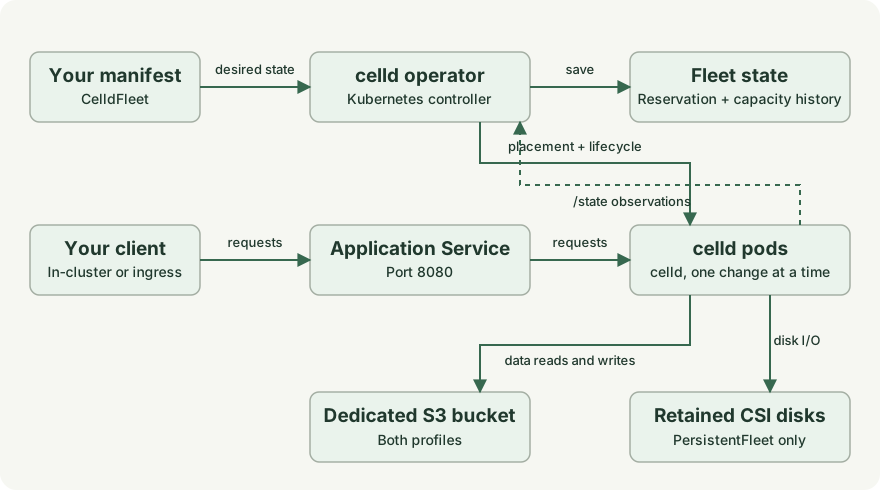
A CelldFleet describes one independent celld cluster. The operator creates its Kubernetes resources and applies lifecycle requests to them. Each fleet has a dedicated bucket and a permanent storage reservation bound to its UID.
| Component | Responsibility |
|---|---|
| celld | Application execution, replication, tiering and recovery. It tolerates the loss of any one member and reports ready only after a restarted member has recovered. |
| Operator | Rendering and applying workloads and their prerequisites, placement, capacity observation, one-member-per-step scale-in, replacing a member that cannot come back on its own, and for PersistentFleet, disk deletion when the fleet is deleted. |
| Kubernetes and CSI | Scheduling, rolling updates, resource versions, storage protection, attachment and volume deletion. |
Both profiles run celld directly; there is no launcher. Bucket uses a
Deployment or Ordered StatefulSet with temporary disk and
CELLD_DURABILITY=bucket. PersistentFleet uses a StatefulSet with retained CSI
disks and CELLD_DURABILITY=fleet. All runtime/recovery members need the
compatible fork.
The operator creates application and headless Services, NetworkPolicies, a PodDisruptionBudget and storage reservations. It has no S3 client or EC2 termination path. You supply buckets, runtime IAM roles, nodes, CSI, ingress, TLS and DNS. PersistentFleet advertises stable per-Pod DNS through its headless Service, including before readiness, so celld can reach retained follower logs after Pod IPs change.
Capacity recommendations and manual requests take the same path: growth in one step, and scale-in one member per step after the previous change has rolled out. Restarts and upgrades are the workload controller’s rolling update; the operator deletes a Pod only to heal a member. See the PersistentFleet lifecycle. The reservation keeps only capacity-policy history; status is reconstructed and clearing it authorizes nothing.
Read the lifecycle contract and runtime control plane for details.
Experimental software for evaluation.Capabilities and limitations· Contribute